Good vs Bad Gutter Guard: How to Spot a Quality Job
Knowing the difference between a good vs bad gutter guard is the single thing that decides whether you’re set for the next 15 years or back up a ladder in 18 months. From the kerb, two jobs can look identical. Get up close, though, and a quality install and a rushed one are worlds apart — different mesh, different fixings, different handling of the tricky bits like valleys and ridge lines. This guide walks you through exactly what to look for so you don’t pay good money for a bad result.
We install gutter guard across Australia every week, so we see plenty of failed jobs that homeowners paid full price for. Most of the time the fault isn’t the concept — it’s cheap materials and lazy workmanship. Here’s how to tell the two apart before you sign, and how to check your own roof if you’ve already had it done.
Start With the Mesh: Aluminium vs Cheap Plastic vs Steel
The material is where most bad jobs are born, and it’s the easiest thing to get wrong because you usually can’t see it clearly from the ground. There are three common types on the market, and they are not equal.
| Mesh type | What happens over time | Verdict |
|---|---|---|
| Powder-coated aluminium | Holds shape, won’t rust, won’t go brittle in UV. Handles ember attack when ember-rated. | The one to choose |
| Cheap plastic / poly | Goes brittle and yellow under harsh Australian sun, cracks, sags into the gutter, and will not survive an ember attack. | Avoid |
| Steel mesh | Rusts over time, especially near the coast, and can cause staining and corrosion where it touches your gutter. | Avoid |
Powder-coated aluminium is the standard we install for a reason. It won’t rust like steel and it won’t go brittle like plastic. Under the sun we get in Australia — where a Colorbond roof can hit 70°C-plus on a January afternoon — cheap poly mesh simply doesn’t last. Within a couple of summers it fades, then it cracks, and once it cracks it stops doing its job. If a quote is suspiciously cheap, the mesh is usually where the corners were cut. Ask directly: “Is this powder-coated aluminium, and what’s the coating warranty?” A vague answer tells you everything.

Don’t Forget Ember Rating if You’re Anywhere Near Bush
If your place is in a designated bushfire-prone area, mesh choice isn’t just about leaves — it’s about your BAL (Bushfire Attack Level) rating. Ember-rated 2mm aluminium mesh is designed to stop burning embers dropping into your gutter and igniting the dry leaf litter that collects there. Gutters full of dry gum leaves are a classic ignition point in a bushfire. A cheap plastic guard offers you nothing here; it’ll melt. If you’re in a bushfire zone and the installer doesn’t even raise BAL ratings with you, that’s a red flag about how much they actually know.
Fixings: The Detail That Separates 15 Years From 18 Months
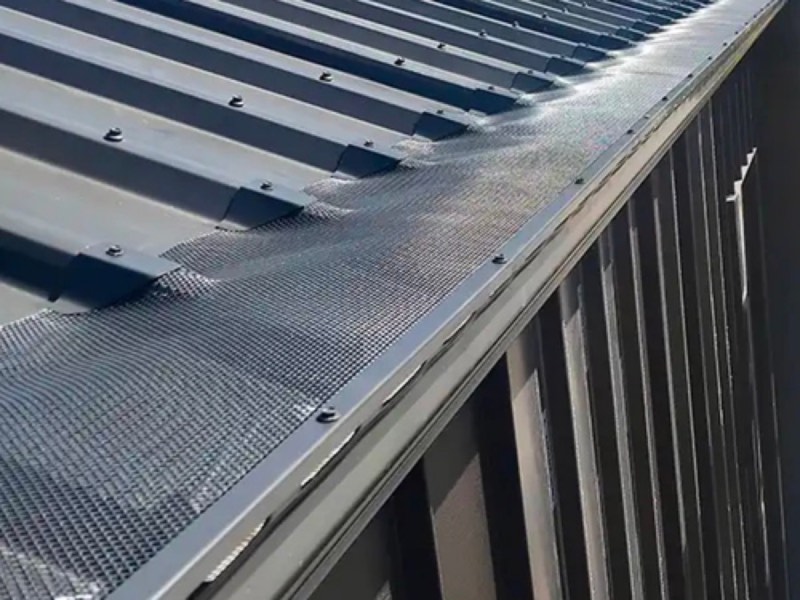
This is the part homeowners never think to check, and it’s the number one cause of gutter guard failure we see. Mesh has to be fixed down properly at both edges — the front lip of the gutter and up under the tiles or against the roof sheet. Get the fixing wrong and wind gets underneath, the mesh lifts, and the whole lot flaps loose in the first decent storm.
-
Good job: The mesh is screwed down with proper self-tapping metal screws or riveted at consistent intervals — you’ll see a neat, even line of fixings. Everything is tensioned so the mesh sits flat and firm, with no gaps for leaves or vermin.
-
Bad job: Mesh held on with adhesive only, a few widely spaced fixings, or clips that pop off. You can lift the edge with a finger. Gaps at the ends where leaves and mice get straight in.
A quick test if it’s already installed: from a ladder (safely), try gently lifting the front edge of the mesh. On a quality install it barely moves. On a bad one it flexes up and you can see daylight underneath. Wind uplift is brutal on our exposed roofs, and mesh that isn’t fixed down properly becomes a sail. We’ve re-done plenty of jobs where the original installer relied on the mesh just “sitting” in place.
Valleys, Ridge and the Tricky Bits
Anyone can lay mesh along a straight run of gutter. The quality of a job shows in how the tricky sections are handled — and this is exactly where a rushed installer cuts corners because it takes time and skill.
Valleys
Roof valleys — where two roof planes meet and channel a huge volume of water — are a common failure point. Water rushes down a valley at speed during heavy rain. If the guard isn’t shaped and secured to let that water flow through while still keeping leaves out, you get one of two problems: either leaves bank up and block the valley, or water sheets straight over the guard and past the gutter entirely, cascading down your wall. Good installers give valleys specific attention. Look at how the mesh meets the valley — it should be neatly trimmed and secured, not just laid over the top and hoped for the best.
Ridge and Roof-Line Terminations
Where the mesh terminates up the roof, it needs to tuck neatly under the second course of tiles or sit correctly against the roof sheet. A good job looks deliberate and clean. A bad job leaves the top edge lifted, gapped, or jammed under the first tile so awkwardly that it lifts the tile and creates a leak path. On tile roofs especially, watch for cracked or chipped tiles — a careless installer walking or levering tiles without care will crack them and leave you with leaks that show up months later.
Tile Roofs vs Colorbond
The two roof types need different handling. On a tile roof, the mesh usually tucks up under a course of tiles, so the fit and the care taken around brittle tiles matters enormously. On a Colorbond (metal sheet) roof, the mesh fixes to the corrugations and the alignment with the ribs has to be right or you get gaps. A quality installer knows both and adjusts accordingly. If someone treats every roof the same way, be wary.

Colour-Match and the Finished Look
Gutter guard should disappear into your roofline, not announce itself. Powder-coated aluminium mesh comes in a range of Colorbond-matched colours — Monument, Woodland Grey, Surfmist, Ironstone and the rest — so the guard blends with your roof and fascia. A good installer measures up the right colour before they start.
A bad job stands out from the street: mismatched mesh colour, a silver aluminium edge glinting against a dark roof, or a raw uncoated trim that’s already starting to weather. It’s not just cosmetic — mismatched or uncoated components often signal that the installer grabbed whatever was cheapest rather than specifying the job properly. If it looks slapped on, it usually was.
Workmanship Red Flags to Watch For
Put the technical stuff aside for a second — some warning signs are obvious to any homeowner who knows to look. Run through this list.
-
Wavy, buckled mesh instead of clean, tensioned straight lines.
-
Gaps at ends and corners where the mesh doesn’t quite meet — an open invitation to leaves, birds and mice.
-
Cracked or chipped roof tiles left behind after the install.
-
Mesh you can lift by hand at the front edge — poor fixing.
-
Debris left in the gutters — a good installer cleans the gutters out before capping them, so you’re not sealing leaves in.
-
No written warranty, or a warranty that only covers the material and not the workmanship.
-
“Supply only” dressed up as a full job — this is the big one, covered below.
The Biggest Red Flag: Nobody Actually Installs It
Here’s something a lot of homeowners only discover after they’ve paid. A chunk of the market sells you gutter guard mesh and then either leaves you to fit it yourself or subcontracts it out to whoever’s cheapest that week. The quality of your job then depends entirely on who happened to turn up.
We do it differently. We’re actual installers — we measure it, we fit it, and we guarantee the work. You never touch a ladder, and there’s one company standing behind both the material and the workmanship. That accountability is worth a lot when something needs looking at down the track. If a supplier can’t tell you clearly who is doing the physical install and who carries the workmanship warranty, that’s your answer. You can read more about how a proper install runs in our guide to how gutter guard is installed.
What a Quality Job Actually Costs
Good work isn’t the cheapest quote, but it doesn’t have to be a rip-off either. Honest pricing on quality aluminium guard, fully supplied and installed, looks roughly like this:
| Option | From (installed) | Best for |
|---|---|---|
| 4mm powder-coated aluminium mesh | from $44 per lineal metre | General leaf and debris protection |
| 2mm ember-rated aluminium mesh | from $46 per lineal metre | Bushfire-prone areas (BAL rated) |
| Typical single-storey home | $2,500–$4,500 fully supplied & installed | Most Australian houses |
If a quote comes in dramatically below this, ask what’s being left out — it’s almost always the mesh quality, the fixings, or the labour. A price that’s too good is the most reliable warning sign of all. If you’d like an accurate number for your specific roof without anyone visiting, our free satellite quote measures your gutters from satellite imagery and gives you a fixed price.
Your Quick Inspection Checklist
Whether you’re comparing quotes or checking a job that’s already done, run through these:
-
Is the mesh powder-coated aluminium (not plastic or steel)?
-
If you’re near bush, is it ember/BAL rated 2mm mesh?
-
Is the mesh fixed with proper screws or rivets at even intervals, sitting flat and firm?
-
Have the valleys and ridge lines been handled neatly, with water flowing through?
-
Is the colour matched to your roof and fascia?
-
Any cracked tiles, gaps at the ends, or debris left in the gutters?
-
Is there one company guaranteeing both material and workmanship in writing?
If you’re specifically weighing up installers around Melbourne, our page on gutter guard installation in Melbourne covers what local conditions mean for your job.
Get It Done Right the First Time
A good gutter guard job keeps you off the ladder for years, protects your home from overflow and blocked valleys, and — with the right ember-rated mesh — adds a real layer of bushfire protection. A bad one costs you the same money and lands you back where you started. The difference is materials, fixings and workmanship, and now you know exactly what to look for.
Prefer to talk it through? Call us on 0468 360 572 and we’ll give you a straight answer about your roof — no ladder, no pressure.
Frequently Asked Questions
How can I tell if my gutter guard is aluminium or plastic?
Aluminium mesh is rigid, holds a crisp powder-coated colour and won’t flex or crack when pressed. Cheap plastic mesh feels flexible, often looks slightly glossy, and over a couple of Australian summers it fades, yellows and becomes brittle. If it’s already faded or cracking within a year or two, it’s almost certainly plastic.
What’s the most common gutter guard installation mistake?
Poor fixing. Mesh that’s only glued down, held with too few fasteners, or left “sitting” in the gutter will lift in wind and fail within a season or two. On a quality install the mesh is screwed or riveted at even intervals, tensioned flat, and can’t be lifted by hand at the front edge.
Do I need ember-rated gutter guard?
If your property is in a designated bushfire-prone area, yes. Ember-rated 2mm aluminium mesh stops burning embers dropping into leaf litter in your gutters, which is a common ignition point in a bushfire. It’s matched to your BAL (Bushfire Attack Level) rating. Cheap plastic guard offers no protection here as it melts.
Why is one gutter guard quote so much cheaper than the others?
Almost always because a corner is being cut — cheaper plastic or steel mesh instead of powder-coated aluminium, fewer fixings, less careful workmanship, or “supply only” where you or an unknown subcontractor does the fitting. A price that’s dramatically below the market is the most reliable warning sign of a bad job.
How much should a good gutter guard installation cost in Australia?
Quality powder-coated aluminium guard, fully supplied and installed, starts from around $44 per lineal metre for 4mm mesh and $46 per lineal metre for 2mm ember-rated mesh. Most single-storey homes land between $2,500 and $4,500 fully installed.
