Gutter Guard for Two-Storey Homes: Cost, Access & Getting an Accurate Quote
If you own a double-storey home in Australia, you already know the problem: cleaning your own gutters is out of the question. A gutter guard for two-storey homes is the sensible fix, but the quotes you get back are often higher than you expected and vary wildly between installers. This guide explains exactly why height changes the price, how safe access actually works on a two-storey job, and how you can get a firm fixed price without anyone climbing a ladder at your place.
We install gutter guard across Australia every week, a fair chunk of it on two-storey and split-level homes. The short version: the mesh itself costs the same as it does on a single-storey house. What you’re really paying for on a double-storey job is safe, legal access to the roofline, and that’s where the numbers move.
Why gutter guard costs more on a two-storey home
A single-storey gutter sits roughly 2.4 to 3 metres off the ground. A two-storey gutter is often 5.5 to 7 metres up, and on a home built on a slope one side can be higher again. Once a working platform goes above around 2 metres, a professional installer is working at height under work health and safety rules, and that means proper fall protection, the right equipment and slower, more careful work.
None of that changes the mesh. Our pricing starts at $44 per lineal metre installed for 4mm aluminium mesh and $46 per lineal metre for 2mm ember-rated (BAL) mesh on a standard single-storey home. On a two-storey home the per-metre material and labour is much the same, but we add a double-storey loading of around $200 to cover the extra access, setup and time. On steeper or trickier roofs that loading can be a little more, which is why an accurate measure matters (more on that below).
Here’s a realistic picture of how a two-storey job stacks up against a single-storey one of the same roof size:
| Item | Single-storey | Two-storey |
|---|---|---|
| 4mm aluminium mesh (installed) | from $44 / lineal m | from $44 / lineal m |
| 2mm ember-rated mesh (installed) | from $46 / lineal m | from $46 / lineal m |
| Height / access loading | none | +$200 (typical) |
| Typical total (average home) | $2,500 – $4,500 | $3,000 – $5,500+ |
Two things push a two-storey total up: the access loading, and the fact that bigger homes simply have more lineal metres of gutter and often more roof valleys, hips and complex junctions to seal. A double-storey with a large footprint and a couple of gable ends can carry 90 to 130 lineal metres of gutter, which is where you get into the upper end of that range.

Access and safety: what actually happens on the day
This is the part homeowners rarely see quoted properly. Getting an installer safely up to a 6-metre gutter line and along its full length is the real work of a two-storey job. There are two common approaches, and the right one depends on your roof.
Ladders and roof anchors (harness) access
On many two-storey homes a qualified installer works off a combination of extension ladders to reach the roof, then moves across the roof itself using a safety harness clipped to temporary or existing roof anchor points. This is quick to set up, keeps costs down, and suits Colorbond and tile roofs with a walkable pitch. It’s the most common method we use.
Harness access has limits, though. A very steep roof (much above about 25 degrees), a slippery or fragile roof surface, or a gutter line you simply can’t reach safely from the roof edge all point toward scaffold instead.
Scaffolding
Where the roof is too steep to walk, the eaves overhang too far, or a whole elevation is hard to reach, scaffolding gives a stable working platform along the gutter line. It’s safer and faster to work from once it’s up, but it adds real cost — scaffold hire and setup on a two-storey home commonly runs several hundred to over a thousand dollars depending on how much of the perimeter needs it and how long it stays up.
A good installer will only recommend scaffold where it’s genuinely needed, and will tell you upfront if your job requires it. Beware a quote that’s suspiciously cheap for a tall or steep home — either scaffold has been left out and will appear as a “variation” later, or corners are being cut on safety.
| Access method | Best for | Cost impact |
|---|---|---|
| Ladder + harness / roof anchors | Walkable Colorbond or tile roofs, moderate pitch | Lower — usually covered by the double-storey loading |
| Scaffolding | Steep, fragile or hard-to-reach elevations | Higher — added as a separate line on the quote |
Why you should never DIY a two-storey gutter guard
It’s worth being blunt here. Falls from ladders and roofs are one of the most common causes of serious injury around Australian homes, and a two-storey fall is not a broken wrist — it’s life-changing. Clip-in DIY mesh kits sold at hardware stores assume you can safely reach and work along your own gutter line. On a double-storey home, most people can’t, and the money “saved” isn’t worth it. This is exactly the situation professional installation exists for: we bring the access gear, we carry the insurance, we guarantee the work, and you never touch a ladder.
Which mesh should a two-storey home use?
The height doesn’t change the material choice, but your location does. Two options cover almost every Australian home:
-
4mm powder-coated aluminium mesh — the workhorse. It keeps out gum and eucalyptus leaf, wind-blown debris and nesting birds and vermin, while letting rain through to your gutters and tanks. Aluminium won’t rust like steel mesh and won’t go brittle and crack like cheap plastic under the Australian sun. Ideal for suburban and coastal homes outside bushfire zones.
-
2mm ember-rated (BAL) mesh — for homes in bushfire-prone areas. The tighter 2mm aperture is designed to block wind-driven embers from lodging in your gutters, and it’s rated to meet Bushfire Attack Level (BAL) requirements. If your home is in a designated bushfire zone, this is the mesh your council and insurer will expect to see.
On a two-storey home the material only costs about $2 more per lineal metre to step up from 4mm to 2mm ember-rated mesh, so if you’re anywhere near bush or grassland it’s usually worth it. Both meshes are aluminium and both are powder-coated to match your roof colour — Colorbond shades like Monument, Woodland Grey, Basalt and Surfmist, or a tile-matched profile — so the finished job blends into the roofline rather than standing out.
Colorbond vs tile roofs on a two-storey home
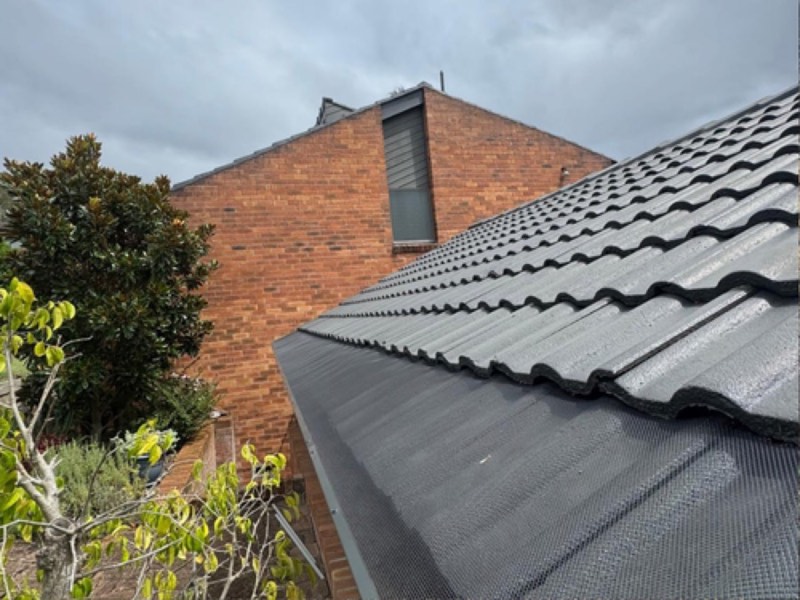
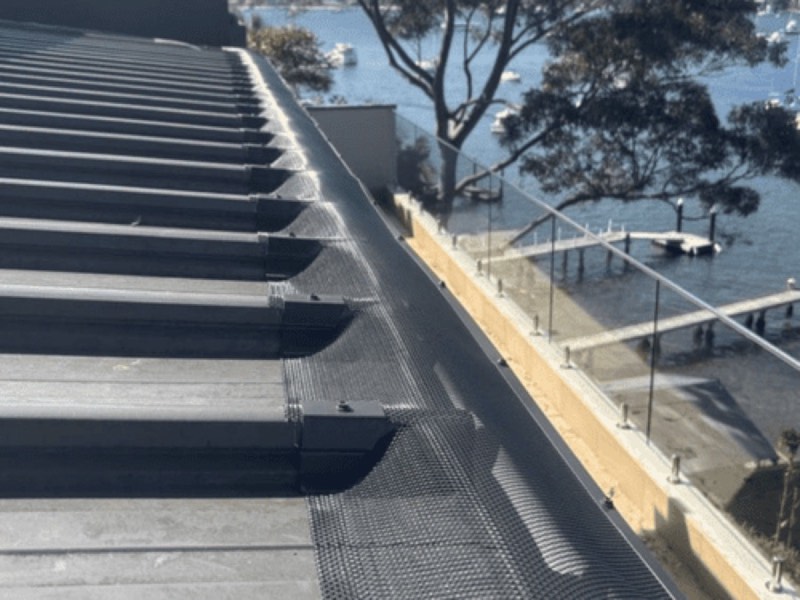
The roof type changes how the mesh is fixed, not the price much. On Colorbond and metal roofs the mesh is screwed to the roof sheet and clipped or bracketed at the gutter edge — a clean, fast install. On tile roofs the mesh usually tucks under the first row of tiles and fixes to a saddle or the gutter lip, which takes a little more fiddling but seals just as well. Both are completely standard for us; the installer just needs to know which one you have, and that’s something we can read straight off a satellite image.
How to get an accurate two-storey quote without a ladder
Here’s the good news for two-storey owners: you don’t need anyone climbing up to price your job. The old-school approach — booking an in-home visit where someone leans a ladder against your house to measure — is slow, and on a double-storey it’s the very thing that makes quoting risky in the first place.
We use a satellite measure instead. Using high-resolution aerial imagery, we measure the full length of your gutter line, count the corners and valleys, identify whether your roof is Colorbond or tile, and confirm it’s two storeys — all from the desk. From that we build a fixed, all-in price: mesh, labour, the double-storey access loading, and scaffold if your roof needs it. No ballpark, no “we’ll confirm on the day”, no ladder against your gutter.
That means three things for you:
-
No visit required to get a firm number — you get your quote by email.
-
A genuine fixed price, so a tricky second-storey elevation doesn’t turn into a surprise variation halfway through.
-
Fast turnaround — most satellite quotes go out the same day.
If you’d rather talk it through, we’re happy to. But most two-storey owners are glad to skip the sales visit entirely. You can get your free satellite quote here and have a real number in your inbox without anyone setting foot on a ladder.
Melbourne and Victorian homeowners can read more on our dedicated gutter guard installation Melbourne page, and if you want to sanity-check the numbers first, our breakdown of gutter guard cost in Australia walks through what drives the price on any home.
Is gutter guard worth it on a two-storey home?
For a double-storey home, more so than almost anywhere. The whole reason gutter cleaning is expensive and dangerous on a two-storey house — the height — is exactly the reason guarding it pays off. Instead of paying a professional to clean second-storey gutters once or twice a year (and risking blocked gutters, overflow into your eaves, and rusted-out guttering in between), you fit quality aluminium mesh once and the gutters largely look after themselves.
On top of that you get real protection: fewer blockages and overflow during heavy rain, less risk of water backing up under your roofline, cleaner rainwater into tanks, no more birds and vermin nesting in the gutters, and — with 2mm mesh — ember protection if you’re in a bushfire area. And you stop climbing ladders for good.
Ready for a fixed price on your two-storey home?
Send us your address and we’ll measure your roof from satellite and email you a firm, all-inclusive price — mesh, install, height loading and any scaffolding — with no obligation and no visit.
Prefer to chat? Call us on 0468 360 572 and we’ll talk through access, mesh and pricing for your place.
Frequently asked questions
How much does gutter guard cost on a two-storey home in Australia?
Most two-storey homes land between about $3,000 and $5,500 fully supplied and installed. Mesh is priced per lineal metre — from $44/m for 4mm aluminium and $46/m for 2mm ember-rated — plus a double-storey access loading of around $200, and scaffold hire if your roof needs it. The exact figure depends on your gutter length and roof complexity, which is why we measure from satellite before quoting.
Why does a double-storey gutter guard cost more than single-storey?
The mesh costs the same per metre. The extra cost is safe access to a gutter line 5.5 to 7 metres off the ground, which means harnesses and roof anchors or, on steep roofs, scaffolding. That access, setup and slower work at height is what the double-storey loading covers.
Do you need scaffolding to install gutter guard on a two-storey home?
Not always. Many two-storey roofs can be worked safely off ladders and a harness clipped to roof anchor points. Scaffolding is used where the roof is too steep to walk, the surface is fragile, or an elevation can’t be reached safely otherwise. We tell you upfront if your job needs it and include it in the fixed price.
Can I get a quote without anyone climbing a ladder?
Yes. We use high-resolution satellite imagery to measure your gutter length, count corners and valleys, and confirm your roof type and number of storeys, then send a fixed all-in price by email. No site visit and no ladder against your house are required to get a firm number.
Which gutter mesh is best for a two-storey home?
4mm powder-coated aluminium mesh suits most suburban and coastal homes and blocks leaf, debris and pests while letting rain through. If you’re in a bushfire-prone area, step up to 2mm ember-rated (BAL) mesh, which blocks wind-driven embers and meets Bushfire Attack Level requirements — usually only about $2 more per lineal metre.
